Nighttime driving is far riskier for trucks than daytime driving. Statistics show that the chance of an accident on a highway at night is more than twice that during the day, and 51.4% of truck driver deaths occur between 11 p.m. and 7 a.m. In intersection crashes involving heavy trucks, blind spots and off-tracking (inner-wheel offset) account for more than 70% of casualties, with a fatality rate above 90%. Poor nighttime visibility combined with blind spots makes “being able to see” the first line of defense for truck safety. When choosing an infrared night-vision onboard camera, focus on night-vision performance, multi-camera coverage, and reliability in tough conditions.
Night-vision capability is not just about whether infrared is included; low-light performance and the type of illumination matter more. Choose cameras with high-sensitivity sensors and low-light imaging that can still produce usable images in dim light. If the camera relies on infrared LED illumination, check whether its effective range is enough to cover the key blind spots around a truck. Trucks have blind spots at the front, rear, and both sides, and a single camera can hardly solve the problem. Four 1080P HD inputs with split-screen display let the driver monitor the area around the vehicle at the same time and truly reduce blind-spot risks. Protection rating is equally important. Trucks constantly face rain, snow, mud, dust, and high-pressure washing, so cameras should be rated at least IP67, and IP68 is even better for harsh conditions. In addition, stable recording storage, wide-voltage input, and frequently used driving features such as Bluetooth hands-free calling should also be considered.
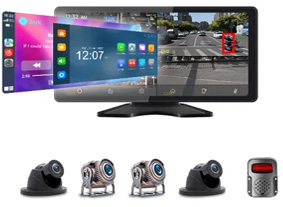
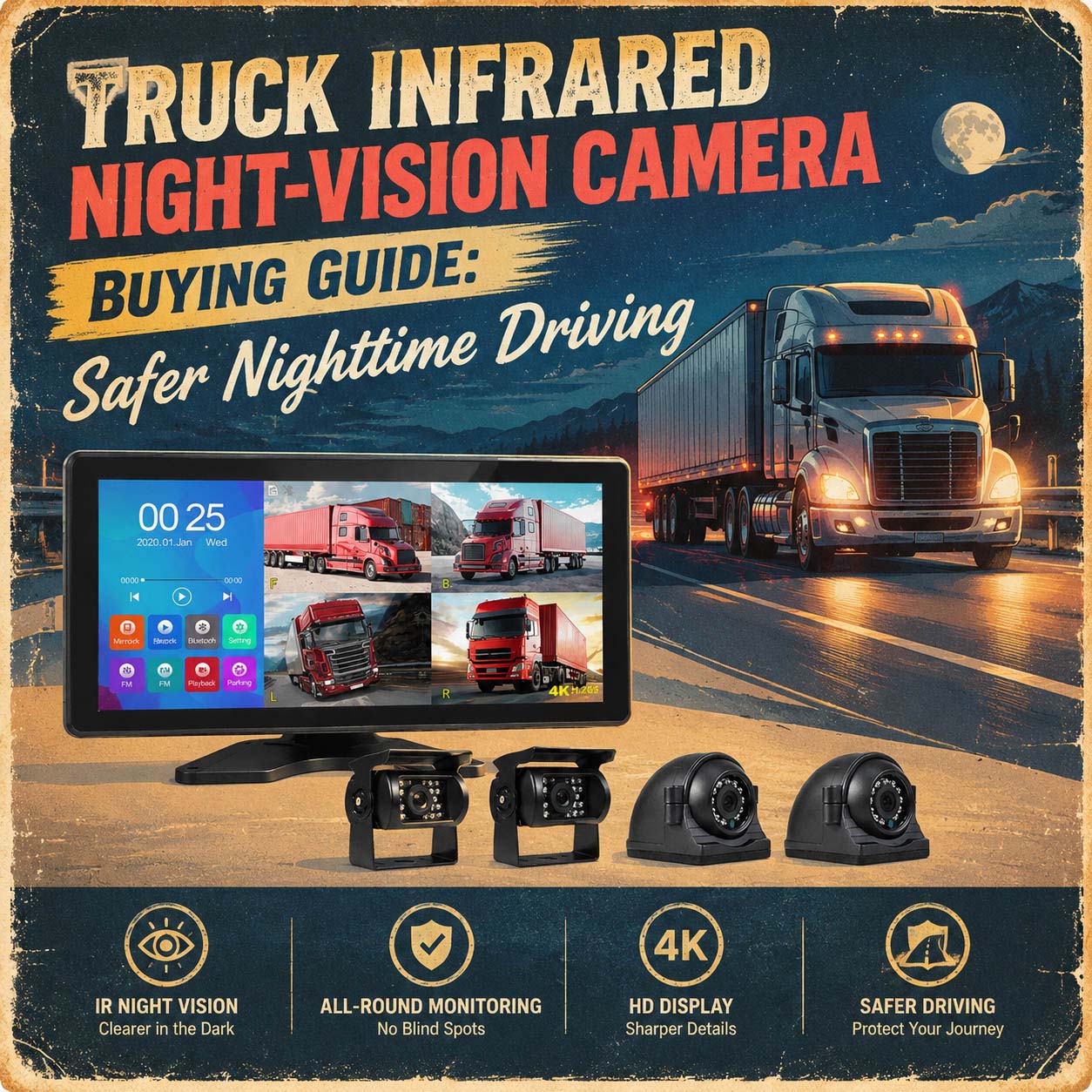
Take the A8 four-channel monitoring system as an example. It comes with a 10.36-inch large quad-split display and four 1080P HD cameras, so front, rear, left, and right views can be shown on one screen at the same time—directly addressing the multi-blind-spot problem of trucks. The DC905 camera in the kit features a 0.01-lux low-light sensor, an f/1.2 aperture, and built-in LED illumination, so it can still produce clear images in dim conditions. The DC002 supports 1080P resolution and digital light-enhanced night vision, with automatic exposure compensation when light is insufficient. Together with the other two cameras, these two night-vision cameras provide 360° coverage. The A8 host supports DVR loop recording with H.264 compression. Its Bluetooth module can connect to a phone for hands-free calls and music playback, reducing the distraction of handling a phone while driving. The 9–36V wide-voltage design is compatible with 12V/24V truck electrical systems, and the IP68-rated cameras are well suited to rain, snow, and washing.
Nighttime driving safety is essentially about turning “unseen risks” into “visible images on the screen.” When buying, pay close attention to low-light night vision, multi-camera coverage, and protection reliability, and then weigh practical features such as Bluetooth calling and recording storage. That is how an infrared night-vision system can truly become a reliable line of defense on the road at night.